Key Topic 4: Artwork and illustrations
It is easy to be caught out with artwork and imagery as we often have a tendency to concentrate on text in materials. These examples will help remind you of the importance of always considering the visual components of promotional material.
Proptopic imagery
Take a look at the following imagery (this case is fictitious):


Now imagine that you are asked to review this new campaign imagery for the product Protopic (tacrolimus ointment), used for the treatment of atopic dermatitis. Your marketing colleagues tell you that this is to show a patient whose atopic dermatitis is under control and hence she can enjoy life again. The campaign will get this across by showing her confidently enjoying swimming on holiday. In one image she is touching her face to show her satisfaction with her response to treatment.
Take a look at the SmPC for this product and then decide whether you would allow this imagery to be used in advertisements for Protopic.
The SmPC for Protopic includes a special warning about exposure to sunlight. This picture shows a woman in sunlight without any kind of protection (e.g sun hat, sun glasses, or even clothing to protect the skin). Whilst it could be argued that she could be wearing a sun protection cream, this is not evident from the picture. The imagery could give the misleading impression that exposure to sunlight is not an issue with this product.
This was the subject of a complaint in the UK (although not with this particular imagery).
Cetraben advert
Consider the following imagery, which your marketing colleagues tell you they would like to use to advertise a cream for the relief of eczema. The concept is one of improved self-confidence because the eczema has been treated successfully.
Would you approve this?
A similar concept was used to advertise Cetraben, an emollient used for symptomatic relief of eczema and the advert was the subject of a complaint in the UK. The advert featured the back view of a young woman walking down a city street. The wind appeared to have lifted her short turquoise skirt to reveal red and white polka dot underwear. The photograph showed her looking over her left shoulder and gasping. The headline read: ‘Confidence to live life their way’ followed beneath by ‘However that might be’.
The company stated that the Cetraben campaign was developed specifically to show the potential negative effects of eczema on people’s lives and demonstrate the positive impact that successful treatment could have in allowing patients to continue with normal activity and improve their self-confidence – hence the headline ‘Confidence to live life their way’.
The UK Authority considered that the suggestive manner in which the young woman’s underwear was exposed was for the purpose of attracting attention to the advertisement, rather than to show the impact of the treatment on a patient’s confidence. The Panel considered that the material did not recognize the special nature of medicines and the professional standing of the audience to which it was directed and was likely to cause offence.

Duaklir visual
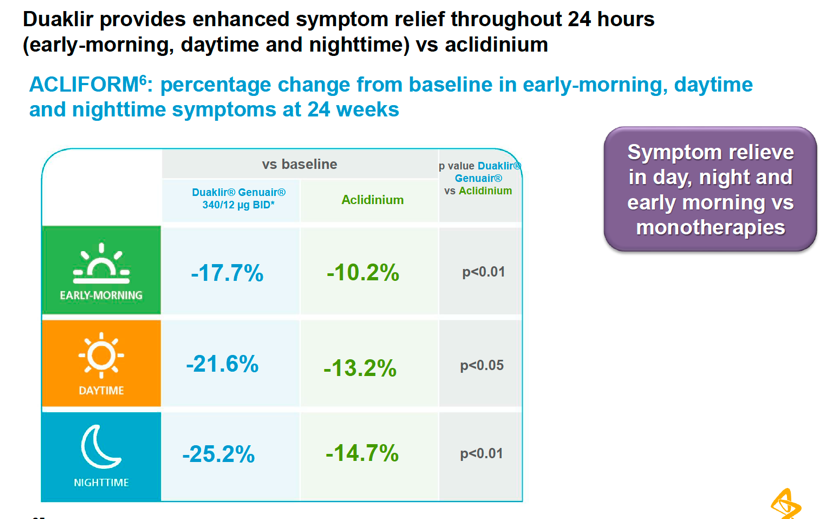
Take a look at the following slide which is part of a promotional slide set for AstraZeneca’s product Duaklir:
Assuming the figures are correct, which of the following do you agree with?
- This slide presents the data in a potentially misleading way
- More information is needed on the slide to approve it
- The data are presented clearly and p values are given so this slide is approvable
- The claims are substantiated by the figures in the table so this is not misleading
Answer
This slide is potentially misleading because it only shows relative reductions in symptom scores and gives no absolute values. If reviewing this slide it would be wise to ask for the absolute values and an explanation of the symptom score used to be added.
Without knowing the nature of the scale used and the absolute values, the percentages can give the impression that the magnitude of change is bigger than it actually is.
Acne visual
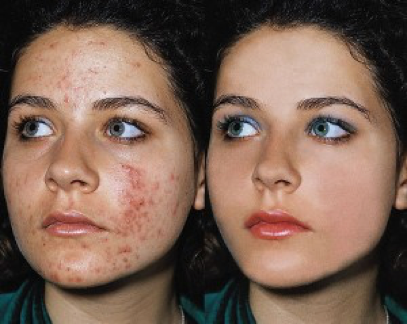
For example would you approve the following ‘before and after’ artwork for an acne treatment?
This may be acceptable if the vast majority of patients achieved this result with the treatment. However if this was not a typical response to treatment it could not be used, even with the caveat ‘individual response may vary’ as it would be deemed an over statement of efficacy.