Key Topic 1: A reminder of the basics of review
As an experienced signatory you will know the importance of establishing what exactly you are reviewing, how the material will be used, its purpose, the target audience and the mode of distribution.
It is important that you take time to ask the right questions and make sure you have adequate information in sufficient detail to conduct a proper review - do not make assumptions as this is a common cause of signatory error.
The following examples illustrate how easy it is to get these basics wrong:

Target audience
A sales representative in the UK was instructed to sell her product to healthcare professionals working in nursing homes, as the product was thought to be beneficial in elderly patients with dementia. She entered a residential home for the elderly and asked to speak to ‘the nurse in charge’. She was introduced to the assistant manager of the home and she gave him some information about her product including a leave-‐piece.
She didn’t know at the time, but it was subsequently revealed that the assistant manager was not a nurse – but he was a qualified social worker.
Later, a doctor treating one of the residents at the home was asked by a member of staff if he would prescribe the product.
The doctor complained that the product had been promoted to the public.
Which of the following do you think are true about this case?
- There was no breach as all the materials used were approved for use by sales representatives
- There was a breach as the representative had promoted her product to a member of the general public
- The social worker was deemed not to be a member of the general public
- There was a breach because the representative used materials which were not approved for use with social workers
Ruling
Although it was deemed that the social worker was not a member of the public, he did not have prescribing rights and would not make decisions about a patient’s care in terms of medicines. Therefore the information that would be suitable for him would not be the same as the information that would be appropriate for a nurse. The materials that the representative had used were approved for use with nurses but not for social workers. A breach had occurred because of use of material with an unapproved target audience.
Mode of distribution
This advert was submitted for global review as a ‘banner advert’. The delivery channel was ‘digital’ and the target audience was ‘healthcare professionals –general’.
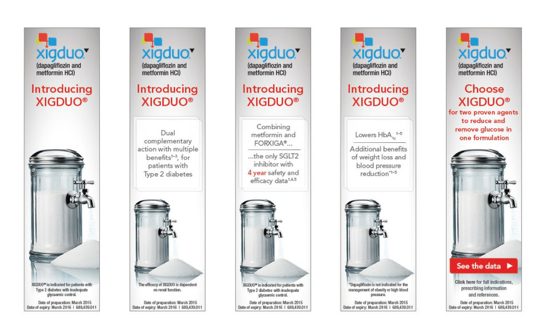
Assuming that all the product claims are factual and can be substantiated-‐ would you approve this banner advert based on this information?
Without knowing exactly where this banner ad is to be placed it cannot be approved.
A delivery channel of ‘digital’ is too vague.
Now assume that the banner ad is to be placed in an international e-‐journal whose target audience is diabetologists and endocrinologists. Would you approve the banner ad based on this information?
This asset is approvable based on the information given.
On further enquiry the asset owner revealed that they wished to place the asset on the ‘LinkedIn’ website. They intended to use a filter so that only members who had declared themselves to be a ‘doctor’ or ‘physician’ would be able to view the banner.
Would you approve the banner ad for this delivery channel?
A business oriented social networking internet based service used mainly for professional networking. It is open to the general public.
LinkedIn is not a suitable delivery channel for promotional material because the filters are inadequate i.e they do not necessarily prevent members of the public from accessing the information. For some UK case law on LinkedIn see PMCPA case number: AUTH/2738/10/14 available on the PMCPA website. In this case the filters used to target health professionals were shown to be inadequate as members of the public could access the promotional information.
Purpose?
Consider the following scenario:
Novartis market Lucentis (Ranibizumab) which is a product used by ophthalmology specialists to treat various types of macular pathology. Novartis organized and paid for a one day educational event for health professionals in Australia which provided presentation skills training in four areas as follows: ‘The presenter’s voice’, ‘Engaging others’, Physical presence’ and ‘Presentation’.
The Australian Code requires educational events organized and funded by pharmaceutical companies to have the primary purpose of enhancing medical knowledge and improving the quality use of medicines. In addition it states that “provision of training that will enhance the interaction of healthcare professionals with their peers or patients may be justifiable”.

The event was attended by three retinal specialist opthalmologists who were described in the Novartis invitation as ‘Novartis Retinal Fellows’.
Which of the following do you agree with?
- This seems like a good quality educational event which fulfills the requirements of the Australian Code
- The educational value of this event is questionable
- The educational objective is questionable given the number of attendees and their relationship with Novartis
- This could be viewed as disguised promotion
- This event could not successfully withstand public or professional scrutiny
- The event could be viewed as a ‘reward’ to those who prescribe Lucentis
Ruling
This event was deemed to breach the Australian Code regarding educational meetings and Novartis received a fine of $90,000. The Committee was concerned that the event was targeted at a group of specialist healthcare professionals who were Novartis retinal fellows, which gave the appearance that the event was a reward for those who prescribed Lucentis. Although the Committee didn’t formally label it as disguised promotion, this would be a legitimate concern to raise as a nominated signatory reviewing this meeting.