Key Topic 2: Non Interventional Studies as the basis for claims
Non interventional studies do not require nominated signatory approval per se. However you will encounter claims made on the basis of data from real world studies and therefore need to understand their limitations.
Materials based upon ‘real world’ evidence should include a statement making it clear that the information is based on real world evidence and is therefore subject to potential bias. For real world studies the term ‘associated with’ should be used to describe findings as opposed to saying a study ‘showed’ a particular effect e.g. In a real world study, using observational data obtained from patients electronic health records, Product X was associated with a reduced annual rate of exacerbations of COPD compared to Product Y.

Consider the following example
The Apollo Study
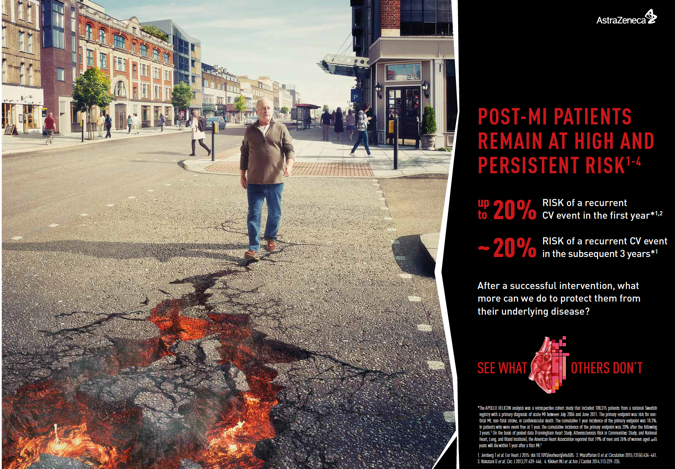
You are asked to approve the following advert which will be placed in international cardiology journals. The advert cites results from the Apollo study.
This advert is part of a campaign being run by your global medical colleagues called ‘See what others don’t’. Its purpose is to raise awareness among cardiologists of the residual risk of recurrent cardiovascular events in patients who have experienced a myocardial infarction.
In order to consider whether this advert is approvable you first need to know a bit more about the Apollo study.
Having familiarized yourself with the Apollo data which of the following do you agree with?
- The statement ‘post-MI patients remain at high and persistent risk’ is not supportable by the evidence the Apollo study supports this statement
- The 20% risk figures may be seen as exaggerating the true magnitude of the risk the risk figures are quoted as approximate which is true– the one year cumulative risk in the study was 18.3%, and the risk in the subsequent 3 years was 20%. However you need to consider the population in the study and how this fits in with data from other sources i.e. the balance of current evidence. Look at Figure 2 in the paper – the risk is very much driven by the more elderly patients in the study. In fact the risk was 6.5% in the under 60s. Almost 20% of patients in the study were >85 years old and their risk is much higher.
- I would need to know what the balance of evidence from clinical trials was with respect to this risk before approving this claims should reflect the balance of evidence. However if it was made very clear that this is referring to a single real world study it might be acceptable.
- It should be made clear that these figures refer to real world data this is also an AZ requirement –although the Apollo study is mentioned in the reference section, there is nothing to indicate the retrospective observational nature of the study. The reader needs this information so that they can interpret the data correctly.
- The results from this real world study have been quoted as predictive statements, which may not be acceptable the predictive statement implies that all patients have this risk. Population based statistics are difficult to apply to any given individual. It would be preferable to state that in the Apollo study, this risk was observed in the overall population.
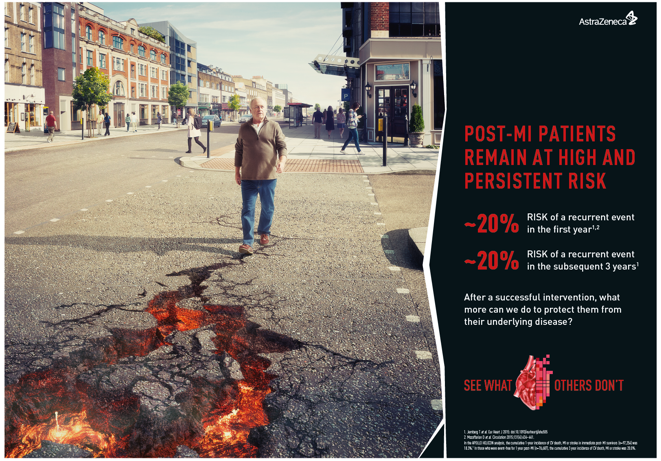
You may also have other opinions on this advert. After some discussion about the above points the advert was changed to this version before dissemination:
‘Up to’ was added before the 20% figure to reflect that the risk is lower in some patients i.e not all patients in the study were at this risk. And more detail about the nature of the study was added to allow the reader some more context around the data being quoted.